Even by conservative assumptions that 5 to 10 per cent of infected individuals develop long Covid, India today may be home to 50 to 100 million infected individuals -- many silently coping with breathlessness, fatigue, palpitations, brain fog, or unexplained clotting tendencies.

"It is unrealistic to expect that COVID-19 pandemic can be eliminated at this stage given that community transmission is already well-established across large sections or sub-populations in the country," the report said.

A number of Indian medical experts on Monday supported calls from an eminent British Indian cardiologist for a full safety review into the use of Oxford/AstraZeneca's Covid-19 vaccine, administered in India as Covishield, over feared serious side effects such as heart attack and stroke.
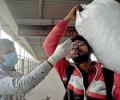
'The fortunate part is that the severity is less. New strains are continuously forming and the virus is getting less severe.'

'We seem to be in a situation where we can do little, and nothing needs to be done anyway.'

The Indian economy has recovered 'handsomely' from the pandemic-induced disruptions, former Niti Aayog vice chairman Arvind Panagariya said on Tuesday, while expressing hope that the recovery will be sustained and the growth rate of 7 to 8 per cent will be restored. Panagariya suggested that the government must now signal its intention to wind down fiscal deficit by cutting it by half-to-one percentage point in 2022-23. "The Indian economy has recovered handsomely, returning to its pre-COVID GDP... "Only private consumption is still below its pre-COVID-19 level," the eminent economist told PTI in an interview.
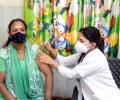
A group of public health experts, including doctors from All India Institute of Medical Sciences and members from the national taskforce on COVID-19, have said that mass, indiscriminate and incomplete vaccination can trigger emergence of mutant strains and recommended that there is no need to inoculate those who had documented coronavirus infection.

The experts said there is a need to relook at the testing strategy in a way that it results in guiding the public health response and effectively limiting the spread of the disease.

India is the seventh worst-hit nation by the COVID-19 pandemic in terms of the number of infections, after the US, Brazil, Russia, the UK, Spain and Italy. While the recovery rate in coronavirus infections is improving and has reached 48.19 per cent in India, there has been steady decline in the case fatality which is now 2.83 per cent, the health ministry said.

The spread of the Omicron variant of the coronavirus has made Indian companies persist with their policy of banning overseas trips and allowing only essential travel within India. The IT services firms, which had planned to ask their employees to return to the workplace, are also waiting and watching the Covid-19 situation before fully opening up their offices. Large conglomerates like the Tatas, Birla, JSW and Reliance are continuing with the mandatory social distancing and masking policies within their office premises.

'There will be increases.' 'There is bound to be, but you have to bear with all this.' 'The focus should be to provide optimum care for those who are in the need.' 'We should focus more on care, better care. Not on testing.'

The corona deaths in India so far add up to 91,149 (September 24, 3.26 pm). It is seven-and-a-half times the number of Indian soldiers slain in all the wars (1947, 1961-1962, 1965, 1971 and 1999) in post-independent India's history, observes Ambassador M K Bhadrakumar.

The Omicron variant carries 'concerning' mutations that may make it more transmissible and allow it to evade immunity, scientists said on Monday, stressing that the one certainty in the uncertainty of the many things unknown is this -- COVID is not a short-term crisis and vaccines are still a critical tool.
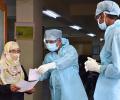
'Call it by whichever name, but there is transmission happening between people.'

Is the worst of the Covid crisis behind India? As cases dip three weeks after Diwali, the answer is a possible yes, say several experts, attributing the downslide to a large section of the population already exposed to the virus during the second wave and a stepped up vaccination campaign.

As its factories resumed operations after over two-month of grim battle against coronavirus, China is busy tapping into the vast business opportunities of export of key medical goods, specially ventilators and personal protection equipment (PPE), across the world, including India, where both private and government bodies are placing orders for the import of these products.
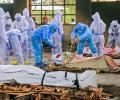
Experts believe that under-reporting is likely to cause an underestimation of the spread of the disease.

'You will still want to take all the necessary precautions, which is the right thing to do.'

'The second wave was more virulent, more aggressive, more transmissible.'

'The prime minister did not think that COVID-19 was a serious challenge as late as March 20.'

'Where did this fungus suddenly come from and get all over the country?'